Danone learns at the speed of business by embracing a knowledge-sharing culture
With Frédéric Hebert, Head of Digital Learning
At a glance
Company
Danone is a global food company that produces dairy, plant-based, and nutrition products, with over 100,000 employees across more than 55 countries worldwide.
Headquarters
Paris, France
Industry
Food production
Employees
100,000+
Danone is a large multinational company with employees in 55 countries. Given the diversity of languages, cultures, and products, there are various learning needs across these various locations.
Frédéric Hebert, Head of Digital Learning at Danone, is responsible for ensuring that all employees get the proper training. Frédéric must also provide tools to employees that allow them to develop both personally and professionally.
To fulfill all learning needs and provide the proper training, he had to find an innovative way to generate learning content.
Key results
- 1,000+ employees actively create learning content
- Adoption of Easygenerator across 30+ countries
- Built a global knowledge sharing culture
- Enabled employees to create and update content independently
- Reduced reliance on external vendors for content creation
Scaling learning across 55 countries with a small L&D team
Challenges:
- Diverse learning needs across 55 countries
- Heavy reliance on external vendors for content creation
- High cost of outsourced e-learning development
- Slow content creation
- Small L&D team with limited capacity
Frédéric knew that in order to meet all learning needs at the right speed, a change was necessary. Traditionally, Danone used a variety of methods to provide training to their employees. Like many companies, they used external vendors to develop their content. They quickly came to see, however, that this was both expensive and slow.
For some learning needs, Danone also empowered their L&D experts. But with a small team, it became difficult to keep up with the demand. Frédéric recognized that the best way to meet all learning needs was to create a culture where employees could share their knowledge and create e-learning content themselves.
But with the complex authoring tools Danone already had in place, this would not be possible. So, Frédéric searched for a zero learning-curve authoring solution that allowed any employee to create e-learning content independently.
Building a knowledge sharing culture with Easygenerator
Frédéric discovered Easygenerator and decided to test the tool during an initial 6-month pilot. He wanted to be sure employees could become the creators of their own learning content.
Frédéric quickly saw success over the 6-month period, with almost 100 authors using the tool to create e-learning. Employees found that they could quickly create learning content on the fly without having to work with L&D, instructional designers, or third-party vendors. Content could also be maintained and updated more efficiently by allowing the employees to own the process.
Best of all, the quality did not suffer. To ensure they had confidence in creating content independently, authors were given onboarding and training sessions with tips and best practices to set them up for success.
“This is the first time I see a solution that can finally answer all my problems. You don't need to be an expert, you don't need to have training, and you don't need to be a designer to use it.”

Results of faster and more cost-effective content creation
After implementing Easygenerator, Danone has over 1,000 authors in more than 30 countries. One of the biggest goals and results Frédéric has achieved is building a knowledge-sharing culture.
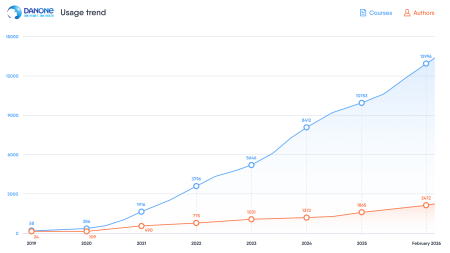
Now, local teams can produce and maintain content entirely independently, and employees can leverage each other’s knowledge. By bringing the content creation in-house, e-learning resources can also be produced and updated at a fraction of the cost.
2,400+
authors
13,000+
courses created
30
countries supported
How Danone enabled employees to share knowledge
Once Frédéric found Easygenerator, he tested the tool during a 6-month pilot to get buy-in from key stakeholders at Danone’s headquarters in Paris, France. During that period, Easygenerator onboarded employees in small groups, so they all knew how to get the most out of the tool.
Within those 6 months, almost 100 authors adopted Easygenerator. After the successful onboarding period in France, it was easy to convince stakeholders in other countries, and Danone started to use Easygenerator globally. As soon as Easygenerator was implemented company-wide, Frédéric started a Workplace by Facebook group that Danone employees can join. The group got lots of new visitors every week, and people joining could follow users and like content. Through this group, employees found out they could participate in Danone’s knowledge-sharing culture and start using Easygenerator.
Now, 2 years after adopting Easygenerator, Danone has more than 1,000 authors in 55 countries.
Q&A
How can companies scale learning across a global workforce?
–
Companies can scale learning by enabling employees to create and share knowledge instead of relying on a central team. At Danone, Easygenerator helped teams across countries create company-tailored training at scale.
How can L&D teams keep up with increasing training demand?
+
L&D teams can keep up by shifting content creation to internal experts in the business. Danone used Easygenerator to remove bottlenecks and meet learning needs faster without expanding the team.
What is the best way to reduce reliance on external training vendors?
+
Organizations can reduce vendor reliance by bringing content creation in house and giving employees the right tools. Danone used Easygenerator to create and update training internally at a lower cost.
What tools help non experts create e-learning courses?
+
Tools with a simple and intuitive design allow employees without a learning background to create courses. At Danone, Easygenerator enabled employees to build training without needing instructional design skills.
How can companies reduce the cost of e-learning development?
+
Companies can reduce costs by enabling employees to create and maintain training themselves. Danone achieved this with Easygenerator, which lowered development costs while increasing output.